What if the right choice isn’t between a day of activities and a retreat, but about giving each the right purpose? The question of CORPORATE RETREAT...
What if the right choice isn’t between a day of activities and a retreat, but about giving each the right purpose? The question of CORPORATE RETREAT VS TEAM BUILDING DAY often comes up when teams need stronger connections, clearer direction or focused time together. If activities don’t address the team’s real needs, even a well-organised event can miss its mark.
Both formats create space away from everyday routines, but they serve different briefs. A focused team-building day can address a specific collaboration goal. A corporate retreat can combine business priorities, team connection and time for discussion. Start with the outcome you want, then choose a format and schedule that give it enough attention.
This guide explains what each format can achieve, how to choose between them and when a blend may work well. It also covers practical planning considerations, including group size, event space and the balance between structured sessions and time to talk. At Quob Park, a historic estate spanning 180 acres, corporate gatherings take place in a setting shaped by the idea of “Your Retreat from the Everyday.” Suite 1707 accommodates 20 to 120 guests.
Key Takeaways
- Distinguish the event format from its main purpose: a retreat can bring business priorities and team connection together, while team-building centres on a specific development aim.
- Use CORPORATE RETREAT VS TEAM BUILDING DAY as a planning question: decide whether your priority is focused collaboration or broader alignment and reflection.
- Compare each format by agenda scope, participant experience and the brief you need the event to fulfil, not by assumptions about duration.
- Set a clear objective before choosing activities. Then consider what participants should discuss, experience or take away.
- Match the setting and schedule to the objective, leaving room for purposeful sessions and natural conversation.
CORPORATE RETREAT VS TEAM BUILDING DAY: What Is the Difference?
The clearest distinction is scope. A corporate retreat is a broader event format: time set aside from normal routines for business priorities, team connection and space to think. A team-building day has a more focused purpose, such as helping colleagues communicate, collaborate or understand how they work together. The formats can overlap, but they aren’t interchangeable labels for the same agenda.
The activity itself doesn’t define the event. A retreat might include a collaborative exercise, while a team-building day might include discussion and reflection. Begin with the team’s need, then choose a structure and setting to support it. CORPORATE RETREAT VS TEAM BUILDING DAY is a useful planning prompt, but the objective should lead the decision.
What is a corporate retreat designed to achieve?
A retreat creates room for focused discussion, shared priorities, reflection or deeper team connection away from the usual rhythm of work. Its agenda can alternate between structured sessions and informal time, giving ideas raised in a meeting room to develop through conversation. The programme might focus on a strategic question, a period of change or bringing colleagues together. Its duration depends on the purpose and schedule, not a fixed definition.
For example, a leadership group may need to agree priorities while making room for different perspectives. A retreat could combine planning sessions, individual reflection and time for conversation instead of squeezing every element into a tightly packed schedule. This balance lets the work remain central while giving participants time to consider what they have heard.
What makes a team-building day different?
A team-building day starts with a defined development objective, such as improving communication, strengthening collaboration or building shared understanding. Activities are a means to that end, not simply a way to fill the agenda. A short debrief can help participants connect an experience with how they work together.
For example, if a project team needs to share information more clearly, choose an exercise that makes listening and coordination relevant, then discuss what participants noticed. A lively activity without that connection may entertain the group but leave the original need untouched. The broader purpose of team building, including the range of interventions it can involve, is outlined in WHAT IS TEAM BUILDING?
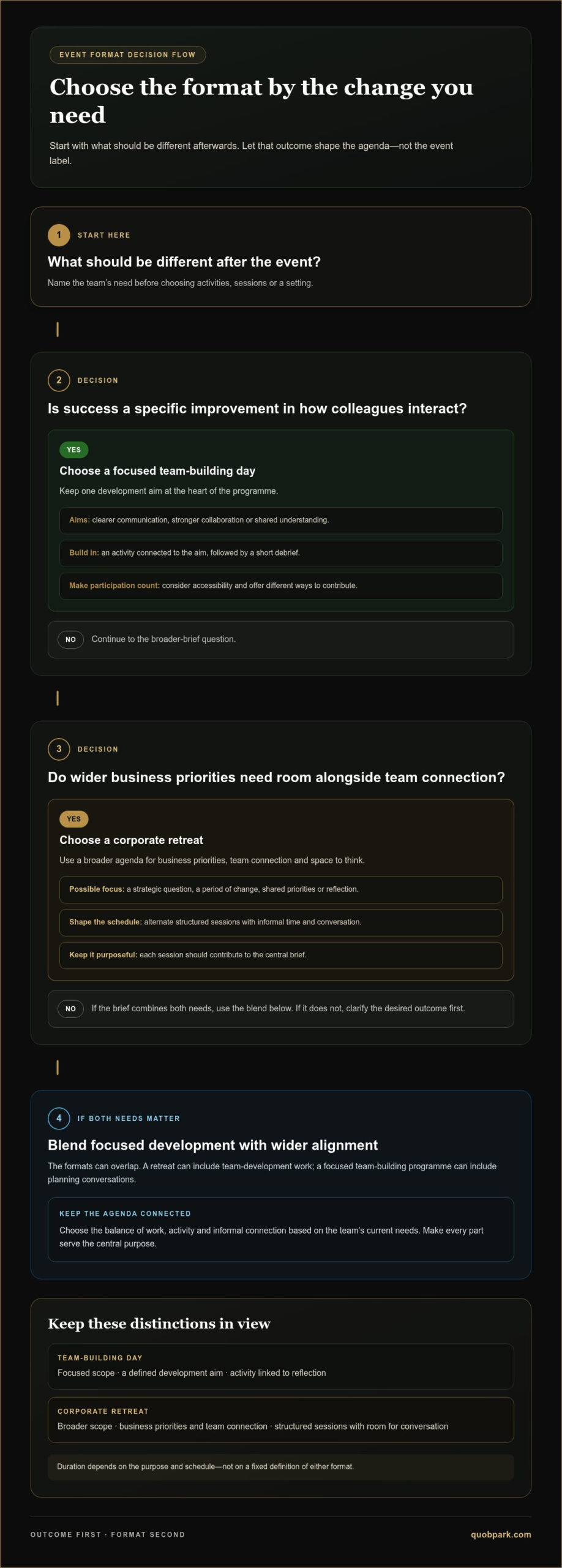
Labels alone won’t settle the choice. A retreat can include team-development work, and a focused team-building programme can include planning conversations. Ask what should be different afterwards. If success means agreed priorities or considered decisions, shape the event around that wider brief. If success means a specific improvement in how colleagues interact, keep that outcome at the heart of the programme. Let the team’s current needs determine the balance of work, activity and informal connection.
How Corporate Retreats and Team-Building Days Create Different Outcomes
The right agenda follows the change you want to support. A team-building day can focus attention on a specific interaction, while a retreat gives wider organisational priorities room to develop alongside team connection. Either format can include purposeful work and time together. The difference is the emphasis and how much of the programme is devoted to each.
Define the format by its primary intended outcome, not its label. This helps prevent a lively programme from becoming disconnected from the issue it is meant to address. Before choosing activities or planning sessions, state the outcome plainly. Do colleagues need to communicate more clearly on a shared task, or does the organisation need space to reflect on direction and agree priorities?
When a focused team-building day is the better fit
Choose this approach when the brief identifies a particular team dynamic or collaboration goal. A shared problem-solving exercise, for example, gives colleagues a common experience to discuss and can reveal how they exchange ideas, listen and make decisions. Include time to reflect so the group can connect what happened during the activity with the way it works together.
Consider participation as carefully as the activity. Think about whether the format is accessible and comfortable for those attending, and offer different ways to contribute. Not everyone will welcome a physical challenge, a competitive game or speaking in front of a group. A well-considered programme gives people meaningful ways to take part without treating one style of participation as the measure of engagement.
When a corporate retreat offers more useful space
A retreat can be a stronger fit when wider priorities need sustained attention alongside relationship-building. That might mean considering a change in direction, bringing perspectives together across teams or making time for reflection before decisions are set. The programme can hold several connected strands, provided each session contributes to the central purpose instead of crowding the schedule with unrelated topics.
Breaks and informal conversation give ideas space to develop between structured sessions. Colleagues can continue a discussion, hear another perspective or return to the next meeting with greater clarity. These moments support the work; they don’t replace it. Rather than assume a retreat will produce a particular performance improvement, agree what useful progress would look like in advance, such as clearer priorities or a documented set of questions for further discussion.
Use the intended outcome to review your draft agenda. If the programme is dominated by one team dynamic, keep the activity and its reflection central. If it needs to address several linked priorities, allow enough time for discussion, decisions and pauses between sessions. A blend can work well too: a retreat may include a focused team exercise, while a team-building day may include planning or reflection. Make the primary purpose clear to participants.
- Focused outcome: improve a defined interaction, such as communication or shared problem-solving.
- Broader outcome: create space for alignment, planning or reflection across connected priorities.
- Blended outcome: combine both, while making the primary purpose explicit.
Once the purpose is clear, choose a setting and schedule that support it. Quob Park’s HISTORIC EVENT SETTING provides a backdrop for purposeful conversation and shared experience.
Corporate Retreat vs Team-Building Day: Compare the Formats Before You Book
A side-by-side comparison can clarify the choice, provided you look beyond the event name. The distinction lies in the scope of the brief and the space the agenda gives it. A retreat may include team-building as one element, while a focused team-building day can include reflection or discussion. Neither format needs to be limited to one type of activity.
| Planning factor | Team-building day | Corporate retreat |
|---|---|---|
| Purpose | Address a defined team-development aim, such as communication, collaboration or shared problem-solving. | Make space for wider priorities, including alignment, planning, reflection and relationship-building. |
| Agenda breadth | Centres on a focused activity or sequence of exercises, with time to reflect on the experience. | Can bring together several connected sessions, team-building, business discussion and informal conversation. |
| Participant experience | Colleagues take part in a shared experience designed to prompt interaction around the stated aim. | Participants move between purposeful sessions and less formal moments that support ongoing conversation. |
| Planning focus | Choose activities that suit the group and directly support the development objective. | Shape the programme around the priorities, sequence and setting needed to give broader work room. |
| Suitable brief | “We want colleagues to practise solving problems together.” | “We need to align on priorities and make room for discussion across the team.” |
Which format suits a specific team brief?
Imagine a newly formed group that needs a shared point of connection. If the main aim is to help people interact and understand one another, a focused day may be sufficient, with a group activity followed by a guided conversation. If colleagues need to examine priorities, hear different views and agree next steps, a broader retreat may offer a more suitable structure. These are planning examples, not guarantees of a particular result.
What to weigh beyond the event label
Consider the size and mix of the group, participant preferences, the importance of each agenda item and how much structured time the brief requires. A programme built around one shared exercise has different needs from one involving several sessions and extended discussion. Account for accessibility and comfort so people can participate in ways that suit them.
Travel and overnight accommodation matter when the agenda, distance or group’s circumstances make them relevant. Dining and informal time can also support a broader programme, but shouldn’t displace its purpose. When comparing a luxury corporate event venue, consider whether the event space, group capacity and schedule fit the brief.
Choose the format that gives the main objective enough room. List the essential agenda items, then ask whether they serve one focused team goal or several connected priorities. If the schedule keeps expanding to accommodate important discussion, a broader retreat may fit better. If every element supports one defined team-development aim, a focused day may be the more coherent choice.
How to Plan a Retreat or Team-Building Day Around Your Team
A thoughtful programme starts with the people attending, not a list of activities. Before comparing CORPORATE RETREAT VS TEAM BUILDING DAY, decide what participants should discuss, experience or take away. A clear objective should guide each decision, from event format to the closing reflection.
- Define the objective. Describe the change or progress you want to support. It might be clearer communication on a project, stronger understanding between colleagues or time to consider shared priorities. Keep the wording specific enough to help you decide whether each proposed session belongs.
- Understand the group. Consider who will attend, how they work together and what could help them participate comfortably. Account for accessibility, different communication preferences and varied confidence with group activities. Participation shouldn’t depend on physical ability, public speaking or personal disclosure.
- Choose the format. If the brief centres on one team-development aim, a focused day may give it appropriate attention. If the group also needs time for broader discussion, planning or reflection, a retreat may provide a more suitable structure.
- Shape the agenda. Arrange sessions in a purposeful sequence. Decide where structured discussion, shared experiences, breaks and informal conversation can best support the objective, then leave room for the group to reflect on what it has learned or agreed.
How to make the agenda feel purposeful, not over-programmed
Resist the temptation to fill every moment. A well-paced agenda gives participants time to absorb ideas and move between sessions without making the day feel like a succession of unrelated tasks. Choose activities because they suit the people attending and the event’s purpose, not simply because they’re familiar. Include a brief discussion after a session so the team can identify useful observations, questions or next steps.
Make participation flexible. An exercise could invite people to contribute through discussion, written ideas or small-group work rather than requiring everyone to take the same role. Avoid activities that put individuals under pressure to share personal information. The aim is a considered shared experience, with room for people to engage in ways that feel appropriate.
When to combine team-building with a wider retreat
A blended programme can suit a brief with both a team-development objective and wider shared work. Place an activity where it supports the agenda: it might open a conversation about collaboration or help participants reflect on how they approach a joint challenge. Follow it with a debrief that connects the experience to the event’s broader purpose. This makes team-building feel integrated rather than added simply to occupy a slot.
For help framing the event brief and practical requirements, use the CORPORATE EVENT PACKAGE PLANNING GUIDE as a starting point for planning a gathering at Quob Park, “Your Retreat from the Everyday.”
Choose a Corporate Event Setting That Fits the Format
A well-chosen setting supports the purpose of an event without dictating its programme. Quob Park is a historic estate spanning 180 acres, described by the tagline “Your Retreat from the Everyday.” For planners weighing CORPORATE RETREAT VS TEAM BUILDING DAY, consider how the space, group size and schedule can serve the brief, whether it calls for focused discussion, a shared team experience or a considered blend.
Start with the practical shape of the gathering. How many people are expected? Will the agenda rely on one central session or move between different priorities? How much structured time does the objective need? Answering these questions helps you assess whether the event space and its capacity fit the group, rather than choosing a venue on atmosphere alone.
Match Suite 1707 and event spaces to the group
Suite 1707 accommodates 20 to 120 guests, a confirmed capacity to use when assessing group fit. Quob Park offers corporate event packages, with the programme shaped around the organiser’s goals. A focused session may need a different layout and flow from a broader programme with multiple discussion points, so let the work planned for the room guide your requirements.
When planning, map the expected group size and essential agenda elements to the event space, then consider how participants will move through the programme. This keeps the venue choice grounded in practical needs while allowing the historic estate setting to lend its own sense of occasion.
Make the next planning step feel straightforward
Before choosing a venue, bring the brief together in a concise outline. Include the event objective, preferred format, participant needs and expected group size. Note the essential sessions and the breathing space the group may need between them. This gives your planning a clear reference point and helps keep the programme aligned with what participants should discuss, experience or take away.
If an overnight stay is relevant to a broader retreat agenda, Quob Park offers 10 luxury B&B or Hotel bedrooms and suites. This can be relevant when the programme is designed around sustained discussion or accommodation is part of the group’s plans. Keep it tied to the brief: an overnight element should support the event’s purpose, not become a default addition.
- Objective: What should the event make space for?
- Format: Does the agenda need a focused team-development emphasis or a broader retreat structure?
- Group: Does the expected attendance fit the chosen event space?
- Programme: Are structured sessions, breaks and informal moments in balance?
With the purpose and practical requirements set out, you can shape a corporate event at Quob Park around your team’s needs.
Give Your Team’s Next Gathering a Clear Purpose
The best event plan starts with a decision your team can act on: what would make this time together valuable? Let the answer shape the format, pace and moments you make room for. Once you resolve CORPORATE RETREAT VS TEAM BUILDING DAY by identifying the objective, planning can move from comparing labels to creating an experience that feels relevant to the people attending.
Keep the brief simple. Set out what the group should focus on, what kind of participation will feel comfortable and what you hope colleagues will carry back into their work. A well-chosen setting can support those conversations, whether the programme centres on one shared purpose or brings several priorities together.
Quob Park offers a historic setting for corporate gatherings, with event spaces and accommodation to consider as you shape your plans. Take the next step and EXPLORE A CORPORATE EVENT AT QUOB PARK. Your team’s next gathering can be purposeful, welcoming and shaped around what matters most.
Frequently Asked Questions
Is a corporate retreat the same as a team-building day?
No. A corporate retreat is a broader event format, while a team-building day centres on a defined development aim; either can include elements of the other. A retreat might reserve one session for a collaboration exercise, while a team-building programme could end with a review of how the group approached a task. To choose between CORPORATE RETREAT VS TEAM BUILDING DAY, write the intended outcome in one sentence before drafting the schedule.
Can a team-building day include business planning?
Yes. Planning can feature if it reinforces the day’s central team objective and has a defined output. For instance, a project group could identify handover gaps after a collaboration exercise, then agree one process question to take back to work. If the discussion needs several agenda blocks, decisions from senior stakeholders or detailed follow-up, planning may need a broader event structure rather than a brief add-on.
Should a corporate retreat include team-building activities?
Yes, if an activity supports the retreat’s purpose and suits the participants. A retreat focused on cross-team communication might include a shared task, followed by a discussion about where information flowed well or became unclear. Avoid adding an activity solely to make the programme feel lively. Consider whether it connects to the event’s aim, offers comfortable ways to participate and leaves enough time for the business conversations around it.
Does a corporate retreat have to be residential?
No. A corporate retreat doesn’t require an overnight stay. A team with a concentrated programme may prefer to travel in and out on the same day, while an overnight arrangement may suit an agenda that needs more shared time or involves participants travelling farther. Base the decision on the programme and practical travel considerations, not the assumption that staying overnight makes an event more serious or valuable.
How do you measure whether a team-building day was successful?
Define success before the event using signs participants can report or produce. If the aim is clearer cross-team communication, note current friction points, then ask afterwards whether roles or handovers feel clearer and what remains unresolved. Gather feedback soon after the event and revisit agreed actions later. Enjoyment is useful feedback, but by itself it can’t demonstrate sustained changes in behaviour or organisational performance.
How many activities should a corporate retreat include?
There’s no fixed number that suits every retreat. Map each proposed activity to an objective and remove anything without a clear role. If an activity needs a debrief, include that conversation in the agenda rather than counting only the activity itself. Then review the sequence to allow enough transition time and pauses. This protects strategic sessions and prevents team-building from becoming a crowded side programme.
Can a team-building day work for employees who dislike group games?
Yes. Team-building can use collaborative tasks without relying on competitive games or personal disclosures. Participants might analyse a work scenario, map a process or discuss observations in pairs before sharing themes with the wider group. Explain the purpose in advance and allow people to contribute in different ways. This keeps attention on useful interaction without treating enthusiasm for games as a measure of commitment.