A longer retreat isn’t automatically more productive. The most useful Executive Leadership Retreat Ideas begin with the work the team needs to do: a...
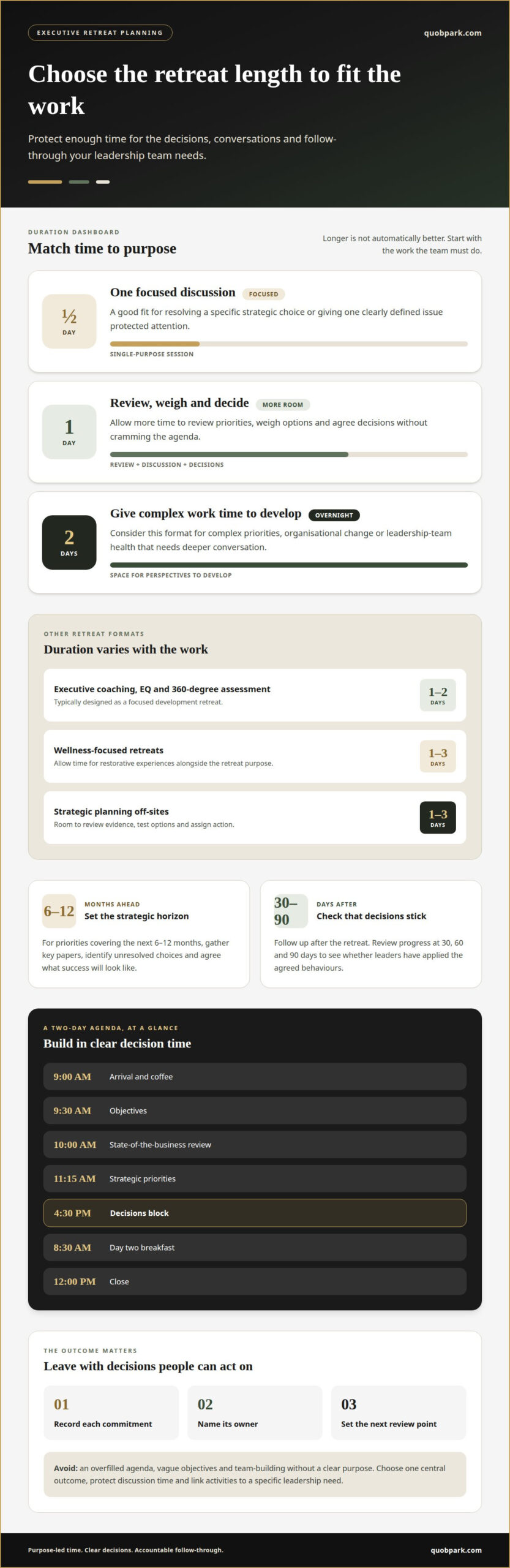
A longer retreat isn’t automatically more productive. The most useful Executive Leadership Retreat Ideas begin with the work the team needs to do: a half-day can suit one focused discussion, a full day leaves more room for planning and decisions, and two days can give complex priorities or leadership conversations time to develop.
Duration is only part of the decision. A considered programme also needs preparation, clear coordination and a thoughtful balance between strategic sessions and time to step outdoors, share a meal and continue conversations informally.
This guide explains how to match retreat length to its purpose, organise the main planning stages and shape an agenda that balances focused work with restorative breaks. It also outlines budget considerations to help you make a practical choice for your leadership team without losing sight of the quality of the experience.
Key Takeaways
- Match the retreat’s length to its purpose: a half-day can suit one focused discussion, while complex priorities may need an overnight format.
- Start planning several months ahead, with clear objectives and an agenda that gives strategic priorities dedicated time.
- Balance structured sessions with outdoor breaks and shared experiences to create room for both focused thinking and informal conversation.
- Build a realistic budget by considering the retreat’s duration, accommodation, meals, activities and coordination needs.
1. HOW LONG SHOULD AN EXECUTIVE LEADERSHIP RETREAT BE?
An executive retreat differs from a standard team off-site because its decisions shape organisational priorities, investment and leadership behaviours. A routine team gathering may focus on project updates or coordination; an executive team needs protected time for strategic thinking, candid discussion and decisions with wider consequences. Choose the duration to fit the work, not to accommodate a packed agenda.
A half-day can work for one focused discussion, such as resolving a specific strategic choice. A full day allows more room to review priorities, weigh options and agree decisions. Choose a two-day retreat when complex priorities, organisational change or leadership-team health need conversations to develop. Executive coaching, EQ and 360-degree assessment retreats typically last one to two days, while wellness-focused retreats typically last one to three days.
Trust needs deliberate attention, especially when leaders must raise difficult issues. Set clear agreements for discussion, then give each person space to explain concerns without interruption. For example, ask the team to identify one recurring decision, why it remains unresolved and what evidence would move it forward. This makes courageous conversation part of useful strategic work.
Team-building activities should reveal how executives collaborate, not distract from the retreat’s purpose. An escape room can bring different leadership strengths to light through shared problem-solving. An outdoor challenge offers another format, from a half-day activity to a multi-day retreat. Match the activity to the team: choose a reflective walk for quieter conversation or a shared task when leaders need to practise coordination.
Measure success through decisions and assigned actions, rather than attendance or enjoyment alone. Record each commitment, its owner and the next review point before the retreat closes. Follow up 30-90 days afterwards, and review progress at 30, 60 and 90 days to see whether leaders have applied agreed behaviours.
Common mistakes include an overfilled agenda, vague objectives and team-building without a clear purpose. Avoid them by choosing one central outcome, protecting time for discussion and linking each activity to a specific leadership need.
2. EXECUTIVE RETREAT PLANNING AND FULL-SERVICE COORDINATION
Begin with the decisions the leadership team must make, then shape the retreat around them. For strategic priorities covering the next 6-12 months, gather key papers, identify unresolved choices and agree what success will look like. Strategic planning off-sites typically last 1-3 days, giving teams room to review evidence, test options and assign action.
Planning several months ahead gives a larger executive team time to align calendars, arrange travel and develop a considered agenda. Appoint a facilitator to guide discussion, keep sessions focused and capture decisions fairly. Before the retreat, share its purpose and any preparation required, so participants arrive ready to contribute rather than spend the opening session catching up.
Choose a venue for the work as well as the setting. A private meeting room supports confidential discussion; comfortable shared spaces let conversations continue informally. For an adventurous destination retreat, coordinating with specialists like Kiddi’s Travel for private guided excursions ensures seamless travel and shared milestones. Considering travel, overnight arrangements, dining and access to outdoor space together helps shape the day’s rhythm and prevents transitions from eating into discussion time.
A two-day overnight agenda can balance preparation, debate and clear decisions. For example, schedule arrival and coffee for 9:00 AM, followed by objectives at 9:30 AM and a state-of-the-business review at 10:00 AM. Place strategic priorities at 11:15 AM, then reserve a decisions block for 4:30 PM. On day two, begin breakfast at 8:30 AM and close at 12:00 PM.
Leave space between sessions for reflection and informal conversation; an agenda packed with presentations can stifle honest debate. The facilitator can record each decision, its owner and the next action, then circulate a concise summary after the retreat. That record turns a shared vision into accountable follow-through and gives the executive team a practical reference for future meetings.
3. Balancing structured strategy sessions with outdoor time
Set the retreat’s purpose before choosing activities. A leadership team facing stalled growth, for example, might focus on customer retention, operational capacity and new opportunities. Begin with a concise business review: what is changing, what is working and where results fall short. Turn the discussion into strategic goals, each tied to a clear decision or question. This gives focused sessions direction and makes outdoor breaks part of a deliberate rhythm, not an escape from the work.
Challenge assumptions before committing to a strategy. Ask leaders to name the belief behind a proposal, then test it against customer feedback, operational evidence or market conditions. An innovation sprint can help: define a business challenge, have participants sketch possible responses independently, then compare and refine the strongest options together. Short, well-framed exercises encourage fresh thinking while keeping discussion relevant. Record unresolved assumptions for later investigation.
Alternate demanding sessions with time outside. After reviewing performance, a walk can give leaders space to continue a conversation beyond the formality of a meeting room. A shared outdoor task can reveal how colleagues communicate as conditions change, while a relaxed meal can make room for quieter voices. Choosing a setting like Water Street Inn, where waterfront grounds and comfortable suites encourage natural breaks, ensures the location supports connection and reflection rather than competing with the strategy.
Strategic foresight can bring the group together around a practical exercise. Describe a plausible future in which customer needs, technology or costs have shifted, then ask what decisions would help the organisation respond. Compare the scenario with current priorities and identify which capabilities deserve investment now. Close by recording the strategic choices, the evidence behind them and each owner’s next action. This connects broad thinking to accountable growth while preserving space for informal conversation and considered debate.
4. Retreat budget and per-person costs
Build the off-site budget in GBP, separating fixed venue costs from expenses that change with attendance. Accommodation, meeting space, meals, refreshments, travel and facilitation all affect the total. An overnight gathering, for example, has different cost components from a daytime meeting. Itemising these costs helps leaders see what supports strategic work, shared time and team-building.
For a useful per-person estimate, divide variable costs by the expected group size, then add each person’s accommodation and travel costs. Keep optional activities separate from essentials so the team can make deliberate trade-offs. A private room may support confidential discussion; an outdoor activity may suit a team seeking connection. The right balance depends on the retreat’s purpose and priorities.
Personal purpose can add reflective value without requiring elaborate materials. Allow 25 minutes: use five minutes for a short video segment, five minutes for independent writing, then invite leaders to share in groups of two to three. Prompts might ask what gives their work meaning, which leadership responsibility feels most important, and what they hope to contribute. This creates a shared moment of reflection while making room for individual motivation.
A personal soundtrack exercise offers a lighter approach to team-building. Ask each executive to choose a song that represents the soundtrack of their life, then create a playlist or invite colleagues to guess each selection. The activity can prompt stories about values, formative experiences and sources of energy. Keep it voluntary and connect the conversation to how the team works together, rather than making entertainment the retreat’s only outcome.
Track these activities as part of the agenda, including any materials, facilitation time and refreshments they require. Compare the full cost with the intended outcomes: alignment, candid conversation and decisions that continue after the offsite. For a retreat shaped around shared hospitality, EXPLORE RETREAT POSSIBILITIES.
Quob Park Estate, Hotel & Spa: Wine-led Weekend Retreats
Quob Park Estate, Hotel & Spa offers Wine-led Weekend Retreats for leadership teams seeking a change of pace and a shared experience beyond the meeting room. Set across 180 acres, the estate provides a tranquil setting for stepping away from daily routines and making space for reflection together.
English sparkling wine can give the gathering a distinctive sense of place. Quob Park Classic Cuvée, Quob Park Heritage Rosé Cuvée and Quob Park Blanc de Blancs offer different expressions to enjoy as part of the occasion. A wine-led retreat may suit teams looking to share time in a memorable setting and explore the estate’s wines.
To discuss a Wine-led Weekend Retreat for your leadership team, contact Quob Park Estate, Hotel & Spa.
Give your next leadership gathering a sense of place
A lasting retreat is more than a pause from routine; it can shape how leaders meet, listen and make space for considered conversation afterwards. Let the setting reflect the leadership culture you want to carry forward: thoughtful, open and connected through shared experience. That intention can guide the details, from the pace of the gathering to moments that invite conversation beyond formal sessions.
For teams drawn to English sparkling wine, Quob Park Estate, Hotel & Spa offers Quob Park Classic Cuvée, Quob Park Heritage Rosé Cuvée and Quob Park Blanc de Blancs. These wines can bring a distinctive sense of place to a leadership occasion. Exploring Executive Leadership Retreat Ideas can start a more purposeful way to gather, shaped around your team’s character and ambitions.
DISCUSS YOUR PLANS WITH QUOB PARK ESTATE, HOTEL & SPA, and take the next step towards a gathering your team can make its own.
Frequently Asked Questions
How long should an EXECUTIVE LEADERSHIP RETREAT be?
Choose a duration that gives the team enough time to complete its central task. A half-day can suit one defined conversation, while a full day allows broader planning. A two-day format can leave room for complex transitions or leadership-team issues. For EXECUTIVE LEADERSHIP RETREAT Ideas centred on one decision, consider the time needed to prepare, discuss and agree next steps.
How Do You Plan a Retreat That Produces Real Decisions?
Frame the retreat around decisions, not a list of presentations. Before the event, circulate a short decision brief for each issue, outlining the choice, relevant evidence and unresolved questions. During the meeting, record the agreed outcome, an owner and the next action. If discussion stalls, identify what information is missing and assign a follow-up rather than disguising uncertainty as agreement.
WHAT MAKES A GOOD STAFF RETREAT?
A good staff retreat connects practical work with relationships and appreciation. One useful structure has four components: bringing the work into the room, building the team, joy and appreciation. For example, discuss a current challenge, recognise a colleague’s contribution, then share an informal activity. This gives the day purpose while making room for the human relationships that support collaboration back at work.
What to do at a COMPANY RETREAT?
Use an appreciative-inquiry exercise to examine a successful project. Ask participants what helped it succeed, which decisions mattered and what conditions could be recreated. Then turn those observations into a short list of practices to carry into future work. This is a practical alternative to a generic team game, especially when the retreat needs to connect shared experience with organisational learning.
What’s Included?
Retreat arrangements depend on the format and agenda. A planning outline should specify what is needed, such as meeting space, accommodation, meals, facilitation, travel arrangements and activities. Separate essentials from optional additions, then assign responsibility for each. This makes the proposed experience clearer and avoids assuming every retreat includes the same arrangements.
What are effective executive leadership retreat activities and formats?
Several EXECUTIVE LEADERSHIP RETREAT Ideas can help leaders practise decision-making, not just discuss it. Try a scenario exercise: present a plausible business challenge, ask each leader to propose a response, then compare assumptions and trade-offs. A facilitated coaching session may suit individual development, while an outdoor activity can encourage a different kind of team interaction. Choose according to the outcome the group needs.