What if the most helpful mother of the bride isn’t the one who takes charge, but the one who knows when to step in and when to let the couple lead?...
What if the most helpful mother of the bride isn’t the one who takes charge, but the one who knows when to step in and when to let the couple lead? Traditions can offer a starting point, but they don’t define your role. It’s understandable to wonder what’s expected, worry about overstepping or fear that an important detail might be missed. A flexible MOTHER OF THE BRIDE DUTIES CHECKLIST can turn those questions into thoughtful, agreed support.
This guide covers practical ways to support the couple before, during and after the wedding, while keeping their priorities at the centre. Use it to discuss planning tasks, emotional support and welcoming guests without assuming every responsibility is yours. Agree what would be useful, what the couple would rather handle themselves and how your role might change as the day approaches. The aim isn’t to follow tradition perfectly, but to be a steady, considerate presence throughout the celebration.
Key Takeaways
- Use the MOTHER OF THE BRIDE DUTIES CHECKLIST to choose practical ways to help before, during and after the wedding.
- Agree responsibilities with the couple, including who makes decisions and when to check in.
- Explore optional support with guest communication, attire, family coordination and event logistics.
- Follow a day-of plan that reflects the couple’s arrangements and the role you’ve agreed to take.
- Ask before handling gifts, personal belongings, photographs or post-wedding messages.
What Does the Mother of the Bride Do? Start with the Couple’s Expectations
The mother of the bride’s role is to support the couple in ways they welcome, whether that means lending a practical hand, offering a calm perspective or simply being present. There’s no universal set of duties, and the number of tasks you take on isn’t a measure of how much you care. The most useful mother of the bride duties checklist is shaped around the couple’s preferences and your own capacity.
Support can be emotional or practical, and one form isn’t more valuable than the other. You might listen as the couple talks through a decision without trying to solve it, or take on a clearly agreed task such as sharing guest information. Some mothers enjoy helping with plans; others offer steady encouragement and leave the details to the couple. Both can be thoughtful contributions. A flexible checklist helps you consider support during planning, on the wedding day and after the celebration, without turning suggestions into obligations.
Which responsibilities are traditional, and which are optional?
Familiar customs may include helping with attire, coordinating with relatives, welcoming guests or lending a hand with arrangements. These are possibilities, not rules every family must follow. Wedding customs vary across families and communities, and wedding traditions and customs encompass many different practices. The couple may want to keep some traditions, adapt others or create a celebration that feels entirely their own.
Offering help is different from taking control. You could offer to accompany the bride while she looks for an outfit, then let her decide whether she’d like your company. Venue planning is another optional area where you might support the couple’s decisions by listening as they weigh what matters to them. Quob Park Estate, Hotel & Spa offers two exclusive wedding venues for couples to consider, including Suite 1707, which accommodates 20‑120 guests, and estate weddings for grand celebrations of 250+ guests. The decision remains theirs.
How can you agree on the role from the beginning?
A short, open conversation can prevent crossed wires later. Ask what kind of support would feel useful, then talk through practicalities: your availability, tasks you’d enjoy taking on and decisions the couple prefer to keep between themselves. Agree how they’ll let you know if their plans or needs change. Clear expectations make it easier to help warmly without feeling responsible for every detail.
Try wording the invitation without pressure: “I’d love to support you in a way that feels helpful. Would you like me to take on anything, or would you prefer I wait until you ask?” You can follow with a gentle, specific offer, such as helping with family communication or attending a planning appointment if they’d find that useful. If they decline, accept their answer graciously. Their response isn’t a rejection of your care; it’s guidance on how to give it.
Before the Wedding: A Mother of the Bride Planning Duties Checklist
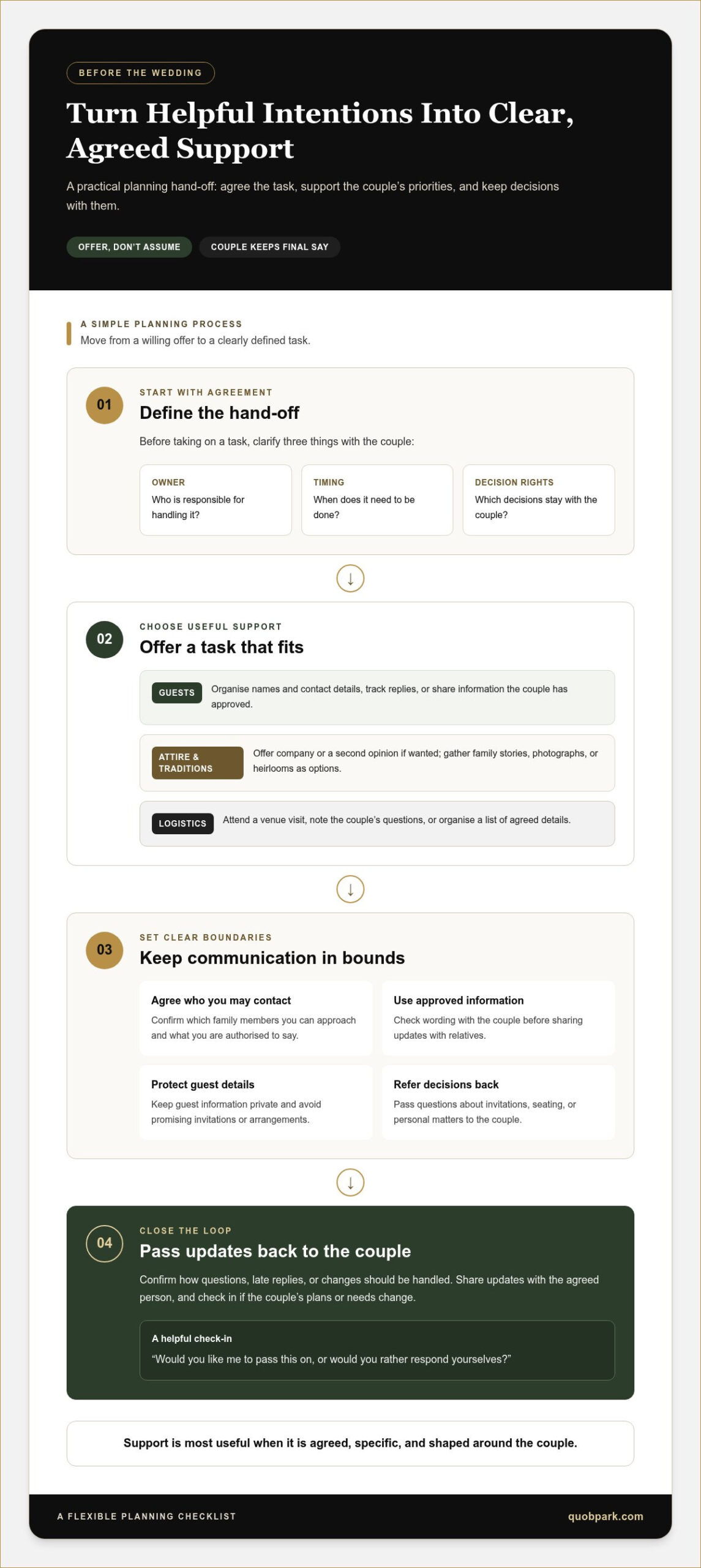
Before taking on a planning task, agree its scope with the couple. For each item, clarify three things: who owns it, when it needs to be done and which decisions remain with them. For example, you might track replies by an agreed date, while the couple keeps final say over the guest list. This simple hand-off makes the MOTHER OF THE BRIDE DUTIES CHECKLIST useful without turning it into an assumed workload.
Choose tasks that suit the couple’s plans and your availability. The suggestions below are starting points, not a test of how involved you should be. The Knot’s MOTHER OF THE BRIDE DUTIES CHECKLIST also outlines traditional and modern possibilities; use any list as inspiration, then shape it around the couple.
Planning and guest-list tasks you could offer to handle
Guest communication can be a welcome practical contribution, particularly when several relatives need the same update. Offer to organise contact details, keep a record of replies or share information the couple has approved. Before contacting anyone, agree which family members you may approach, what you’re authorised to say and how you’ll pass questions or changes back to the couple.
- Guest details: Offer to organise names and contact information. The couple decides who is invited; agree a deadline for returning any updates.
- Replies and updates: You could track responses or share agreed information with relatives. Confirm the wording and who handles late replies or sensitive questions.
- Family coordination: If relatives need help with practical arrangements, offer to be a point of contact. Agree the limits of that role and refer decisions about invitations, seating or other personal matters to the couple.
Keep guest information private and avoid promising an invitation or arrangement on the couple’s behalf. A helpful question is, “Would you like me to pass this on, or would you rather respond yourselves?”
Dress shopping, family traditions and wedding details
For attire, offer company or a second opinion only if the bride would enjoy it. Ask what kind of feedback she wants, and let her lead the decision. The same care applies to family traditions: you could gather stories, photographs or heirlooms that might be meaningful, but share them as options rather than expectations. The couple can decide what belongs in their celebration.
Event logistics are another area where a defined task can help. You might attend a venue visit, note questions the couple wants answered or organise a list of agreed details. If they’re considering a setting for the celebration, explore QUOB PARK WEDDINGS together as one part of their planning. Suite 1707 accommodates 20‑120 guests, while estate weddings can host grand celebrations for 250+ guests. Any follow-up should have a clear owner, deadline and decision boundary, so your assistance supports their choices rather than quietly taking them over.
How to Set Boundaries and Share Wedding Duties Without Overstepping
A long list of traditional tasks can make it seem as though one person is expected to manage the wedding. That isn’t a rule. Traditions may inspire ideas, but the couple’s preferences, your availability and the support of other family members should shape who does what. A MOTHER OF THE BRIDE DUTIES CHECKLIST works best as a shared planning tool, not a list of obligations to complete.
Before making calls, confirming arrangements or changing a detail, ask the couple first. A specific offer is easier to accept or decline than a general promise to “take care of everything”. Try: “Would it help if I gathered venue options for you to consider?” Suggestions are welcome when invited, but they shouldn’t become decisions unless the couple agrees. For a venue-related task, you might share QUOB PARK WEDDINGS as an option, while leaving the choice and any follow-up to the couple.
How do you offer help without taking over?
Make the offer, agree the limits and leave room for a no. If the couple declines, thank them for being clear and don’t press the point. If they reassign a task or change their mind, treat that as an update to the plan, not a criticism of your help. Supportive involvement works best when it respects the couple’s control over their own decisions, as explored in MODERN MOTHER OF THE BRIDE ETIQUETTE AND BOUNDARIES.
A shared task list can turn good intentions into clear, manageable arrangements. Record who owns each task, the agreed deadline and when the next update is due. Include anything the couple wants to handle themselves, so a well-meant offer doesn’t become an unwanted intervention. Brief check-ins at agreed points are clearer and calmer than repeated messages or assumptions about progress.
How can a shared task list prevent misunderstandings?
Use a simple table to distinguish decision-making from support. “Who decides” identifies where the final say sits; “who helps” names the agreed contribution. Check-in points keep everyone informed without requiring constant updates.
| Task | Who decides | Who helps | When to check in |
|---|---|---|---|
| Venue shortlist | The couple | Mother gathers options, if invited | On the agreed review date |
| Guest updates | The couple approves the message | Mother shares it with agreed relatives | After replies or questions come in |
| Family tradition | The couple chooses whether to include it | Mother shares the story or item | Before plans are finalised |
For example, instead of saying, “I’ll sort out the family guests,” agree: “I’ll send the wording you approve to these relatives by Friday, then let you know who replies.” That commitment has a defined owner, deadline and boundary. If the couple later prefers to send the message themselves, acknowledge the change, update the list and step back graciously. Clear agreements make support feel generous, not intrusive.
On the Wedding Day: A Practical Mother of the Bride Checklist
The wedding day is not the moment to take on every loose end. Follow the plan you’ve agreed with the couple, and let the designated coordinator or named contact handle urgent logistics. Your MOTHER OF THE BRIDE DUTIES CHECKLIST should leave room for a meaningful contribution: being present, welcoming and reassuring without creating extra decisions.
“A mother’s most useful role on the wedding day is the agreed support that lets the couple feel cared for and free to enjoy their celebration.”
Before the ceremony: calm, practical support
Use this chronological guide as a menu, not a set of instructions. Each task depends on the couple’s wishes and the role you’ve agreed to take.
- On arrival: Check in with the couple or the agreed coordinator. Confirm where you’re expected to be and whether there’s a particular task you’re handling. Avoid adding last-minute suggestions unless someone asks for your input.
- While getting ready: If invited, help with agreed details such as keeping personal items close to hand or passing along a message. Follow the bride’s lead; don’t adjust clothing, belongings or the schedule without permission. A calm presence may be more useful than another decision.
- As guests arrive: Greet relatives or help direct guests only if this has been assigned to you. If someone asks about a detail you don’t know, guide them to the named contact rather than guessing or changing the plan.
During the celebration: welcome guests and respect the plan
Once the ceremony begins, focus on the part you’ve agreed to play. You might welcome relatives, help a guest find the right place or share directions if the couple has asked you to. If an unexpected issue arises, pass it to the designated coordinator instead of trying to resolve it yourself. That hand-off keeps responsibility with the person appointed to manage logistics and helps avoid drawing the couple into small issues.
- After the ceremony: Follow the couple’s plan for photographs and moving between parts of the celebration. Offer practical help only where it’s been requested, and leave the photographer or coordinator to guide the sequence.
- At the reception: If you’ve agreed to host, help guests feel welcome and direct questions to the right person. Otherwise, enjoy the occasion, join conversations and be available to the couple without hovering.
- As the day unfolds: Keep your agreed contact details accessible, but don’t feel you must monitor every detail. Raise an urgent concern with the coordinator; save non-urgent thoughts for another time.
A graceful day often depends on knowing what not to manage. If the couple is choosing where to celebrate, Quob Park Weddings offers two exclusive venues: Suite 1707 accommodates 20‑120 guests, and estate weddings can host grand celebrations for 250+ guests. Let the couple’s chosen arrangements guide your support.
After the Wedding: Close the Loop and Keep Supporting the Couple
Once the celebration is over, a little practical help can ease the transition back to everyday life, but it’s still the couple’s choice what they’d like you to handle. Before collecting, sorting or returning anything, agree what needs doing, who owns it and whether your help is wanted. The final stage of a MOTHER OF THE BRIDE DUTIES CHECKLIST is less about completing every loose end and more about leaving the couple feeling supported, not managed.
Which post-wedding tasks might be useful?
Some tasks are straightforward to share if the couple asks. You could help gather cards and agreed belongings from the venue, sort items into clearly labelled groups or coordinate a return they’ve already arranged. If they’d like help with dress care or organising gifts, ask what they want done before moving, storing or opening anything. These items may be personal, and the newlyweds may prefer to deal with them in their own time.
- Cards and gifts: Offer to collect or organise them only with the couple’s direction. Agree where items should go and how you’ll hand them over.
- Personal belongings: Help gather items the couple has identified, rather than deciding what to keep, pack or move yourself.
- Photographs and messages: Ask before sharing images, tagging the couple or sending post-wedding updates to relatives. They may want to choose what’s shared and when.
- Remaining arrangements: If there are agreed returns or collections, clarify who is responsible and when the task should be completed.
Not every item needs immediate attention, and you don’t need to take responsibility for tasks the couple hasn’t given you. A brief handover can close the loop: review what remains, name its owner and ask whether any further help would be welcome. If the couple would rather manage the rest themselves, let them.
How can support continue without adding pressure?
Give the couple room to settle into married life. A simple message such as, “I loved celebrating with you. If you’d like help with anything still outstanding, just let me know when it suits you,” offers support without asking for an immediate reply or creating another task. They may welcome a chance to talk, or simply appreciate your congratulations and the space to enjoy this new chapter.
After the planning, details and celebration, the most enduring gift may be ordinary and tender: listening without rushing to advise, sharing in their happiness and respecting their independence. Quob Park Weddings brings the occasion together with the spirit of “Your Retreat from the Everyday”. Your support can be just as gracious: offered warmly and guided by what the couple wants.
Let Your Support Grow With the Celebration
The most meaningful next step is a conversation, not a perfect plan. Choose one or two ways you’d genuinely enjoy helping, then invite the couple to shape the rest. A MOTHER OF THE BRIDE DUTIES CHECKLIST can guide that conversation while leaving room for their priorities and your relationship to evolve beyond the wedding.
If the couple is still imagining the setting for their celebration, Quob Park Weddings offers two exclusive venues. Suite 1707 accommodates 20‑120 guests, while estate weddings can host grand celebrations for 250+ guests. Exploring the possibilities together can be a lovely way to support their vision without taking the decisions out of their hands.
EXPLORE QUOB PARK WEDDINGS and discover a setting for the couple’s next chapter. Whatever role you take, your thoughtful presence can help make the celebration feel truly their own.
Frequently Asked Questions
Does the mother of the bride have to pay for the wedding?
No, the bride’s mother isn’t automatically responsible for paying for the wedding. Families arrange contributions in different ways, so discuss any offer openly with the couple and the family members involved before plans rely on it. Be clear about what the contribution covers and whether it comes with any expectations. A MOTHER OF THE BRIDE DUTIES CHECKLIST can include non-financial support too, such as listening, welcoming guests or helping with an agreed practical detail.
What should the mother of the bride wear?
Choose an outfit that feels comfortable and suits the couple’s plans and stated dress code. Ask whether they have preferences about colours or formality, then coordinate sensitively with the other parent if that would be helpful. There’s no single colour rule that applies to every wedding, and the ceremony style may influence what feels appropriate. Most of all, choose something you can wear with ease and enjoy throughout the celebration.
Does the mother of the bride give a speech?
She may give a speech if it suits the couple’s plans, but it isn’t required at every wedding. Ask whether they’d welcome a few words and, if so, agree the timing and format so it fits naturally into the celebration. A warm, personal message might share a happy memory, express your hopes for the couple or offer a heartfelt toast. Keep it suited to the occasion and the couple’s wishes.
Who does the mother of the bride walk down the aisle with?
There’s no single arrangement for every wedding procession. The order may reflect the couple’s preferences, cultural practices, venue arrangements or the ceremony format. Ask the couple or ceremony organiser what they have planned and whether they’d like you to take part in a particular way. Confirm where to be and when to move before the day, rather than relying on assumptions based on tradition. That small clarification can help the ceremony feel composed.
What does the mother of the bride do at the rehearsal?
Her involvement depends on the couple’s plans and the invitation she receives. A rehearsal may involve walking through the ceremony sequence and showing participants where to stand or move. Listen for any cues that apply to you, such as when to enter or where to wait, and ask privately if your part isn’t clear. You don’t need to direct the practice unless the couple has specifically asked you to take on that responsibility.
Can the mother of the bride share duties with the mother of the groom?
Yes, the two mothers can share tasks if the couple and both families are comfortable with the arrangement. Divide responsibilities by interest and availability, and make each hand-off specific. For example, one person might communicate an approved update to one group of relatives, while the other handles a separate agreed task. Keep invitation decisions and sensitive messages with the couple, and note who is doing what to avoid duplicate effort.