
What if a memorable corporate retreat still proves difficult to justify? Stronger connections, clearer priorities and renewed energy matter, but...
What if a memorable corporate retreat still proves difficult to justify? Stronger connections, clearer priorities and renewed energy matter, but translating them into business outcomes can be challenging. Ensuring ROI on a corporate retreat starts before you choose the venue: agree what success looks like and how you’ll recognise it afterwards.
It’s understandable to question how to measure benefits that can feel intangible, particularly when considering a premium setting. Luxury alone doesn’t prove impact. Instead, connect every programme choice to a defined objective. A vineyard visit, shared meal or wellness session should each have a clear role in the retreat’s purpose.
This guide will help you set measurable objectives, establish useful before-and-after indicators, and assess venue and programme elements against the outcomes you want. It will also show how to report results and lessons credibly, whether your focus is strategic alignment, collaboration or wellbeing. At Quob Park, a 180-acre vineyard estate, accommodation, dining and experiences can come together in a setting shaped around your retreat’s aims.
Key Takeaways
- Define the business outcome you want before choosing a retreat format, then select measures that can show progress towards it.
- Capture a baseline and gather evidence after the event to distinguish countable results from changes in engagement and working relationships.
- Compare day events, residential retreats and work-focused offsites against your objective, weighing relevant features and trade-offs.
- When ensuring ROI on a corporate retreat, agree in advance which documented benefits and investments you’ll include in the calculation.
- Shape the venue and programme around the intended outcome, so accommodation, dining and experiences each have a clear purpose.
What does ROI on a corporate retreat really mean?
Return on investment (ROI) is the business value an organisation can reasonably connect to a retreat, considered alongside the full investment it required. That investment includes more than the venue or programme: factor in planning effort, staff time, travel and time away from normal work. The intended return might be a decision reached, a shared plan agreed or working practices that can be observed afterwards.
A retreat can combine discussion, shared experiences and time away from the usual workplace. For a general overview of WHAT IS A CORPORATE RETREAT?, see Wikipedia. For measurement, the important distinction is between what participants enjoyed and what the organisation intended to achieve.
A useful definition: “Retreat satisfaction describes how participants experienced the event; ROI is the evidence that the event contributed to an intended business outcome, weighed against the effort and investment involved.”
Direct outcomes are relatively straightforward to record: a set of agreed priorities, a documented action plan or a decision that had been delayed. Other returns, such as trust, engagement and cohesion, are less tangible. They still matter, but need relevant evidence, such as follow-up feedback, examples of improved cross-team communication or progress on agreed actions. A positive end-of-retreat survey is valuable feedback, not proof that business performance changed.
Which outcomes can a corporate retreat reasonably influence?
Start with a specific organisational need, then choose an outcome the retreat can plausibly support. If teams are working in silos, a useful aim might be to clarify handovers and agree how colleagues will share information. If decisions are repeatedly revisited, the retreat could help leaders align on priorities and responsibilities. These are contributions the programme may support, not guaranteed results. Productivity, retention and revenue depend on wider conditions, so avoid attributing changes in them to the retreat alone.
Keep the outcome close to the people attending and the work they do. “Improve collaboration” is a broad aspiration; “agree a consistent process for sharing project decisions across teams” gives participants something specific to work on and gives organisers evidence to review afterwards.
Why should objectives come before venue decisions?
A clear purpose helps determine whether the team needs focused working sessions, facilitated discussion, time for relationship-building or a considered blend. It also guides the setting: a quiet space may support strategic planning, while shared dining or a vineyard experience may complement a programme focused on connection. Choose each element for its role, rather than assembling enjoyable activities without a unifying aim.
For example, if the need is stronger coordination between departments, set an objective to agree shared priorities and clarify decision-making responsibilities. Build the agenda around those conversations, choose a format that gives the relevant colleagues time to work together, and later review the priorities and responsibilities they agreed. This is the foundation of ensuring ROI on a corporate retreat: each choice, from agenda to evaluation, serves the same purpose.
How to measure corporate retreat ROI before and after the event
A credible assessment begins before the event, while you can still decide what evidence to collect. Keep the method proportionate: select a small number of measures that reflect the objective and make sensible use of information the organisation already holds. A focused comparison is more useful than a long list of indicators nobody has time to review.
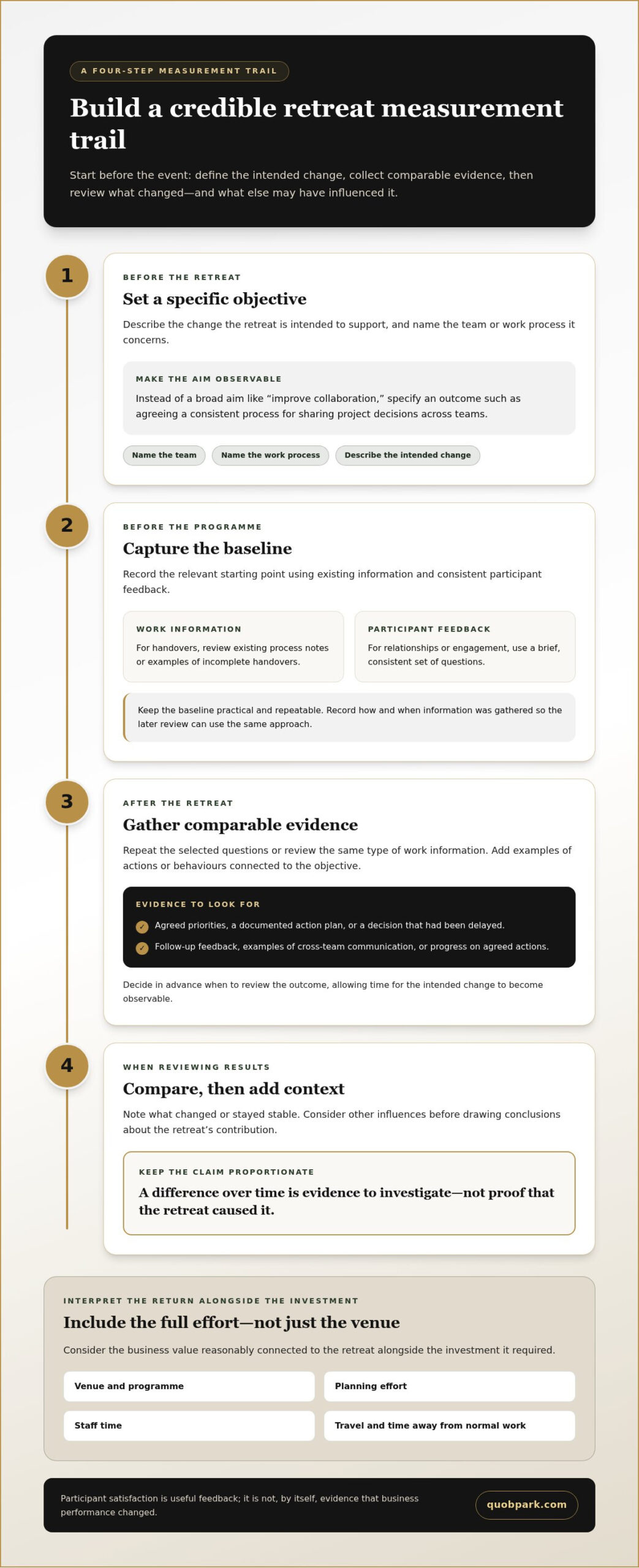
Use this four-step sequence to create a clear measurement trail:
- Set an objective. Describe the change the retreat is intended to support, and identify the team or work process it concerns.
- Capture a baseline. Record the relevant starting point before the programme, using existing records and consistent participant feedback.
- Gather evidence. Repeat comparable measures after the retreat, and collect examples of actions or behaviours linked to the objective.
- Review outcomes. Compare the evidence, note what changed or remained stable, and consider other influences before drawing conclusions.
Before-and-after comparisons need context: a difference over time is evidence to investigate, not proof that the retreat caused it. This distinction is central to ensuring ROI on a corporate retreat without overstating what the event achieved.
What should you measure before the retreat?
Choose a starting point that fits the objective. For clearer project handovers, this might include existing process notes, examples of incomplete handovers or feedback from the colleagues involved. For engagement or working relationships, use a brief, consistent set of questions that participants can answer candidly. Decide in advance when to review the outcome, allowing enough time for the intended change to become observable.
Keep the baseline practical and repeatable. If the organisation already tracks relevant project information, use it rather than introducing a complicated new system. Record how and when the information was gathered so the later comparison uses the same approach.
How should you assess outcomes after the retreat?
Repeat the selected questions or review the same type of work information, then describe the result plainly: what improved, what stayed much the same, and what needs longer observation? Pair participant feedback with operational evidence where appropriate. People may report that conversations felt more constructive; project records or examples of changed working practices can help show whether that perception is reflected in day-to-day work.
Keep satisfaction separate from team-level indicators. Enjoyment can tell you about the experience, but it doesn’t establish that a work process changed. Note relevant developments since the baseline, such as changes to team membership, priorities, management or workload. These may help explain the evidence, so include them in the review rather than overlooking them.
Finish with a concise record of the objective, measures, findings and limitations. If the evidence is mixed, say so. A measured account gives decision-makers a sounder basis for refining the next retreat than a claim of success based only on timing or positive feedback.
How to compare retreat formats and venues against your ROI goals
Once you’ve defined the outcome, compare each format and venue feature by the role it can play in achieving it. A day event may suit concentrated discussion; a residential retreat may create more room for informal conversation. Neither is inherently better. The right choice depends on the objective, participants’ needs and the evidence you plan to review.
As you assess LUXURY CORPORATE EVENT VENUES, consider more than appearance. Ask how the setting supports the agenda, what evidence each programme element could generate, and what trade-offs it brings. This keeps a considered setting in service of the business purpose, rather than treating prestige as a return in itself.
Which retreat format fits the outcome you want?
Match the format to the work. Focused sessions can give a team space to develop a plan or reach decisions. A residential format may suit an objective that benefits from shared time and conversation beyond formal sessions. A work-focused offsite can preserve dedicated working time in a different setting. Compare the agenda time each allows, the needs of those attending and how you’ll capture outcomes.
| Objective | Format | Venue feature | Expected evidence | Trade-off |
|---|---|---|---|---|
| Agree a strategic direction | Work-focused offsite | Quiet meeting space | Documented priorities and decisions | Less time for informal interaction |
| Build familiarity across colleagues | Residential retreat | Accommodation and shared dining | Participant reflections and examples of new connections | More time away from normal routines |
| Address a defined topic efficiently | Day event | Convenient, focused event space | Agreed actions and session outputs | Less opportunity for extended conversation |
How can venue features support a measurable programme?
Give every feature a clear job. Accommodation can support a coherent residential schedule, while shared dining can create space for conversation that complements formal sessions. Wellness treatments may fit an objective centred on wellbeing; a vineyard experience may provide a distinctive shared activity when connection or reflection is part of the purpose. Neither feature is evidence of impact by itself.
Quob Park’s 180-acre estate brings accommodation, gourmet dining, wellness and vineyard experiences into one setting. The useful comparison is not simply which amenities feel most impressive, but which ones support your planned sessions and participant experience. When assessing LUXURY CORPORATE EVENT VENUES, weigh programme fit alongside comfort, access to the spaces you need and the evidence you expect to collect.
For ensuring ROI on a corporate retreat, make the comparison visible before committing: write down the objective, format, relevant venue feature, likely evidence and trade-off for each option. That record helps explain why the final design fits the purpose. To explore a setting for a purpose-led gathering, consider QUOB PARK CORPORATE EVENTS.
How to calculate and report retreat ROI without overstating results
A calculation is only as credible as the definitions behind it. Before reporting a return, agree what counts as an investment, which benefits qualify and what evidence supports each figure. Keep the scope consistent: if staff time is included among the costs, for example, use a documented method to value it rather than counting some inputs and overlooking others.
A simple structure is:
ROI = (documented benefits − documented investment) ÷ documented investment
This expresses the net documented benefit in relation to the investment. It doesn’t make every outcome suitable for conversion into pounds. If a retreat supported clearer communication or stronger working relationships, report those as qualitative findings unless the organisation has a defensible way to value them. Avoid implying that a positive percentage captures every benefit or limitation.
A change observed after a retreat does not, by itself, prove the retreat caused it. Treat the result as part of a reasoned assessment, alongside the baseline, evidence quality and other developments that may have influenced the outcome. This is a more credible approach to ensuring ROI on a corporate retreat than presenting a precise-looking figure without explaining its assumptions.
What belongs in a credible retreat ROI review?
Set the calculation boundaries before reviewing results. Consider whether your agreed investment includes planning effort, participant time, travel, accommodation, programme elements and follow-up work. Use records the organisation can substantiate, and apply the same scope when comparing one retreat with another.
For benefits, include only outcomes that can be explained and supported by available evidence. A completed action plan, for instance, can be documented; a perceived improvement in team cohesion can be summarised from participant feedback and observed examples. Keep estimates clearly labelled and separate from directly measured results. Don’t assign invented monetary values to non-financial outcomes.
- Directly measured: supported by an identifiable record or repeatable measure.
- Estimated: calculated using stated assumptions, with the method made visible.
- Qualitative: described through feedback, examples or observed changes, without presenting it as a financial return.
This separation gives decision-makers a fair view of what the figures show, what they suggest and what remains uncertain.
How can leaders turn findings into the next decision?
Make the report concise enough to use. Summarise the original objective, starting point, evidence gathered, results and limitations, then state what should happen next. Note which programme elements participants found useful and which would benefit from adjustment. If a result needs longer observation, say so rather than forcing a conclusion into the report.
For future retreats, retain the same measures where they still fit the objective. Consistency can make comparisons more meaningful, while a changed purpose may call for different indicators. Use each review to refine the next decision: continue an element that supports the intended outcome, adapt one with mixed evidence, or reconsider the format if it didn’t serve the programme’s needs.
To shape a retreat around your organisation’s aims, EXPLORE CORPORATE EVENT PACKAGES.
How Quob Park can bring a purpose-led corporate retreat together
A well-considered retreat begins with the organisation’s purpose, then brings the right setting and programme elements around it. Quob Park Estate, Hotel & Spa is a 180-acre estate where corporate event packages, accommodation, dining and experiences can form part of a joined-up plan. The aim is not to assume that an elegant setting creates business value by itself, but to make each choice serve the retreat’s intended purpose.
For a team working towards shared priorities, the programme might centre on business meetings and focused discussion, with shared dining creating space for informal conversation. If wellbeing is part of the objective, wellness treatments may complement the agenda. A vineyard experience can offer a distinctive shared activity when connection or reflection is relevant. These elements shape the participant experience; assess any business impact against the organisation’s own evidence.
How can the setting support a coherent retreat experience?
Accommodation at the Old House Hotel & Spa can support a residential programme, while gourmet dining gives colleagues a shared setting beyond formal sessions. Selected wellness or vineyard experiences can add a different rhythm to the schedule when they fit its purpose. Bringing these elements together can make the retreat feel considered and cohesive, without treating comfort or enjoyment as proof of measurable organisational change.
For organisations ensuring ROI on a corporate retreat, the practical question is how each element contributes to the experience and the stated objective. A vineyard tour, for example, may suit a programme that values shared exploration, while a work-focused session may need uninterrupted time for planning. The estate’s 180-acre scale provides a sense of place, not a measure of business impact.
What are the next steps for planning a corporate retreat?
Begin with the outcome the organisation wants to support, then consider the agenda, format and experiences that fit. Quob Park’s corporate event packages provide a starting point for bringing the gathering together. As you shape the plan, keep the purpose visible: every activity should have a reason for being there, whether it supports focused work, participant wellbeing or time to connect.
- For strategic discussion: prioritise meeting time and a clear agenda.
- For shared connection: consider dining or a vineyard experience that gives colleagues time together.
- For wellbeing: consider whether wellness belongs in the programme and how it supports the retreat’s intention.
These are planning considerations, not guaranteed outcomes. The value of a tailored plan lies in its coherence: participants can understand why they are there, and organisers can later review the retreat against its original aims. Explore Quob Park’s corporate event packages as a next step, and begin an objectives-first conversation about shaping a retreat around what your organisation wants to achieve.
Make your next retreat decision with confidence
Before planning begins, turn the organisation’s priority into a short decision brief: what needs attention, who should be involved, and what evidence would make the gathering worthwhile. This gives colleagues a shared point of reference as plans take shape and helps keep the programme focused when attractive options compete for space on the agenda.
That discipline is at the heart of ensuring ROI on a corporate retreat. It doesn’t require certainty about every outcome; it requires a clear purpose, thoughtful choices and an honest review of what followed. A well-designed experience can create valuable conditions for progress, while careful measurement helps leaders decide what to carry forward.
Bring your objectives to the planning conversation and explore a setting that can be shaped around them. EXPLORE CORPORATE EVENT EXPERIENCES and take the next step towards a retreat with purpose, care and a considered plan for assessing its value.
Frequently Asked Questions
How do you measure the ROI of a corporate retreat?
Measure it by linking the retreat’s intended contribution to evidence the organisation can verify, then reviewing who is responsible for acting on it. For example, if the aim is to settle cross-team ownership, identify the decision owner and record agreed responsibilities in a shared document. This makes ensuring ROI on a corporate retreat less dependent on broad impressions and gives leaders something concrete to revisit when they assess progress.
What should you measure before and after a corporate retreat?
Choose evidence that fits the specific team and its work, such as whether project decisions have a clear owner, whether agreed actions appear in team records, or how participants describe a particular working relationship. Decide who will gather each piece of information and keep its scope consistent. If a retreat involves several teams, note which groups contributed evidence so changes in one team aren’t mistaken for a wider organisational shift.
Can a corporate retreat improve employee engagement?
A retreat can create space for employees to share perspectives, discuss priorities and build stronger connections, but it can’t guarantee lasting engagement. The effect depends on what happens afterwards, including whether managers act on concerns and teams follow through on commitments. If engagement is a goal, consider what workplace conditions may be affecting it, and plan how leaders will respond to themes raised during the retreat.
How do you calculate the cost and return of a company retreat?
First agree how the organisation will account for its investment, including staff time and work displaced by attending. Then document benefits the company can support with evidence, taking care not to count the same benefit twice under different labels. Keep assumptions visible, especially if estimates are used, and report financial outcomes separately from qualitative gains. This gives decision-makers a clearer view of what the calculation includes and what it leaves out.
What happens if a retreat receives positive feedback but business metrics do not change?
Treat positive feedback as evidence that participants valued the experience, not as proof that the intended business outcome occurred. Check whether the objective was within the retreat’s influence, whether enough time has passed to observe a change, and whether agreed actions were put into practice. If the original aim still matters, adjust the follow-through or programme design; if priorities have shifted, record that learning before planning another event.
Which corporate retreat format is best for measurable outcomes?
The best format is the one that gives participants suitable conditions to work on the chosen objective and makes relevant evidence practical to collect. A focused meeting may suit a decision that needs concentrated discussion, while a residential gathering may better support an aim involving sustained interaction. Consider participants’ responsibilities and access needs, too. A format that excludes key contributors or leaves little room for the necessary work can undermine the plan.
Is a luxury venue worth it for a corporate retreat?
A luxury venue can be worthwhile when its setting and hospitality serve the retreat’s purpose and create a coherent experience for participants. Consider whether its meeting environment, accommodation or dining supports the agenda, rather than treating refinement as evidence of return. Compare the venue’s contribution with the organisation’s priorities and planned investment. If a feature is enjoyable but unrelated to the objective, its appeal alone may not justify including it.