The most flexible wedding plan isn’t always the one with the most choices, and the most convenient isn’t automatically the best value. The DIY...
The most flexible wedding plan isn’t always the one with the most choices, and the most convenient isn’t automatically the best value. The DIY WEDDING VS ALL INCLUSIVE PACKAGE decision comes down to which tasks you want to own, how much time you can give to planning, and what you want your celebration to feel like.
DIY can appeal if you want creative freedom and enjoy organising details. An all-inclusive package may appeal if you’d rather have some arrangements brought together. But package labels can hide important differences, so compare the written inclusions and responsibilities, not just headline descriptions. This guide will help you weigh creative control, coordination and clarity, then assess value using the same categories for each option.
Your venue can shape both the day and the work involved in planning it. Quob Park Weddings includes two exclusive wedding venues within Quob Park Estate, a historic estate spanning 180 acres. Grand celebrations can host up to 250+ guests, while Suite 1707 accommodates 20-120 guests. As you weigh how much to organise yourselves, consider which setting and scale suit the experience you want to share. Quob Park’s promise is “Your Retreat from the Everyday”.
Key Takeaways
- DIY means leading the sourcing and coordination, not necessarily making every detail by hand.
- Compare the DIY WEDDING VS ALL INCLUSIVE PACKAGE by mapping who handles research, decisions, setup and coordination.
- Use a like-for-like worksheet to sort each wedding element into included, optional, self-arranged or not applicable, without relying on assumed costs.
- Start with your priorities and available time, then separate must-haves from details you’d be happy to delegate.
DIY Wedding vs All-Inclusive Package: What Does Each Approach Mean?
The central difference is who takes responsibility for organising, coordinating and deciding the details of the day. With a DIY wedding, the couple leads more of the work, from selecting suppliers to shaping the schedule. An all-inclusive package may bring several elements together, but the label alone doesn’t tell you which decisions remain yours or what is covered.
That distinction matters more than the name. Two weddings described as “DIY” can involve very different levels of professional help, just as packages can include different combinations of venue, catering and coordination. For a useful DIY WEDDING VS ALL INCLUSIVE PACKAGE comparison, focus on responsibilities and written inclusions rather than assumptions about either approach.
What does a DIY wedding involve?
DIY means couple-led sourcing and coordination, not necessarily making everything by hand. You might research suppliers, manage communications, build a schedule and arrange décor, while hiring professionals to deliver selected elements. You can set the creative direction and delegate practical delivery, such as floral installation or day-of coordination. DIY describes who organises the celebration, not its aesthetic or budget.
For example, you could choose the colour palette and table styling yourselves, then hire a supplier to provide and arrange the finished décor. Another couple might enjoy managing every detail. Neither approach is more “DIY” because of how much is handmade. The useful question is which decisions and tasks you want to own.
What should an all-inclusive wedding package mean to you?
“All-inclusive” is a broad planning label, not a universal checklist. One offer might combine venue hire and catering; another may describe a different set of services or coordination. A WEDDING PLANNER may assist with design, planning and management, but that role is distinct from the package label itself. Compare the written inclusions, options and responsibilities rather than assuming the phrase guarantees a particular arrangement.
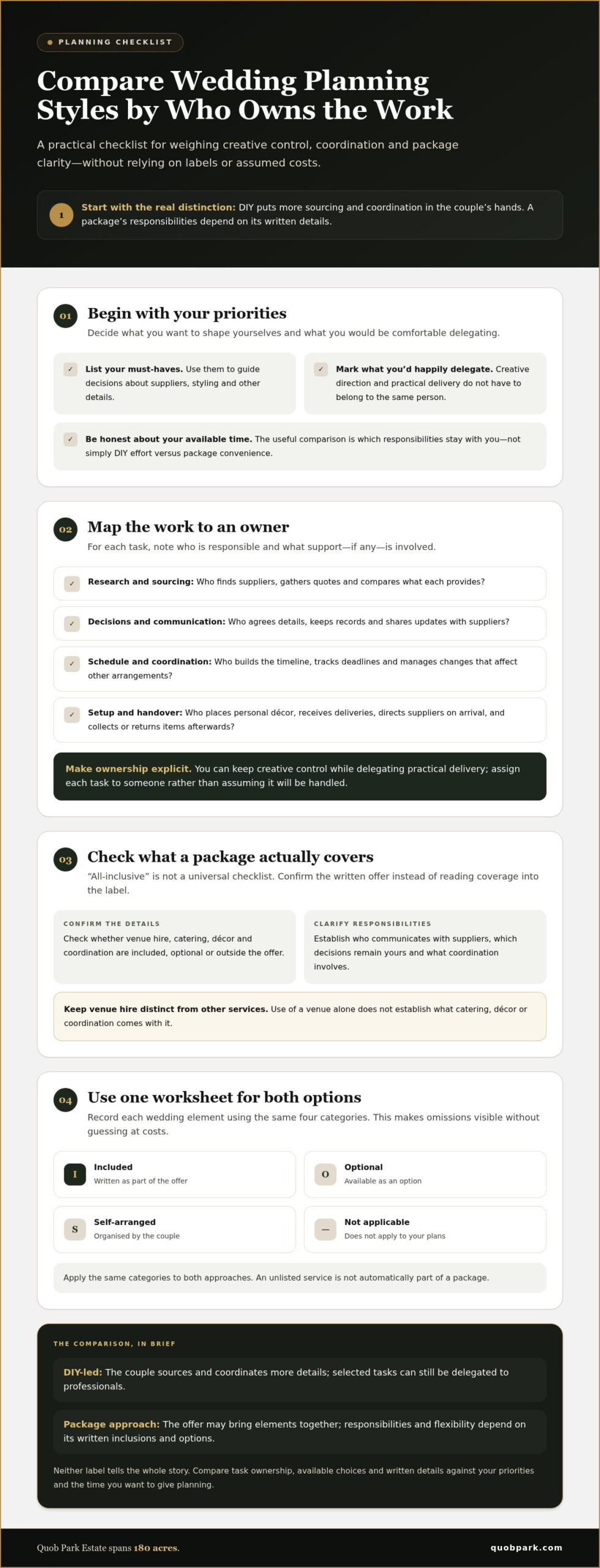
For clarity, record each element as included, optional, self-arranged or not applicable. That makes omissions visible without guessing at costs or treating an unlisted service as part of the offer. Venue hire describes the use of a venue; it doesn’t, by itself, establish what catering, décor or coordination comes with it. Quob Park’s WEDDING VENUE HIRE gives you a setting to consider separately from assumptions about package contents.
| Planning area | DIY-led approach | Package approach |
|---|---|---|
| Responsibility | The couple sources and coordinates more details. | Responsibilities depend on the written offer. |
| Flexibility | Choices can be shaped around personal priorities. | Flexibility depends on the options provided. |
| Coordination | The couple manages timelines or delegates selected tasks. | Coordination may be part of the offer; establish its scope from the details. |
| Supplier management | The couple may research and communicate with suppliers. | Check which suppliers, if any, are covered and who manages arrangements. |
In short, DIY puts more organising in your hands, while an all-inclusive label only becomes meaningful once you know exactly which responsibilities and details it covers. Neither approach suits every couple. The right fit depends on the involvement and creative control you want.
DIY Wedding Planning vs Package Convenience: Where the Work Really Goes
The workload often sits in the follow-through that brings visible decisions together. You might enjoy choosing a menu or refining the look of a room, but still need to track replies, reconcile timings and pass each decision to the right person. The practical comparison isn’t simply DIY effort versus package ease. It’s about which responsibilities stay with you and how much time and attention you’re comfortable giving them.
Where DIY planning asks for time and coordination
DIY planning usually involves a sequence of connected tasks rather than one large project. You might gather quotes, compare what each supplier provides, agree details, record deadlines and share updates between people. If one choice changes, such as the order of the reception, other arrangements may need to shift too. A shared schedule and one central record of decisions can help prevent details from getting lost across messages.
Give setup and handover their own place in the plan. Decide who will place personal décor, receive deliveries, direct suppliers on arrival and collect or return items afterwards. Assign each responsibility rather than assuming someone else will take it on. You can keep creative control and still delegate practical jobs; just make ownership clear and give the person responsible enough time to complete each task.
What package convenience can and cannot settle
A defined set of arrangements may reduce the number of separate choices you need to make, particularly if it brings together elements that matter to you. But convenience depends on clarity: who communicates with suppliers, what decisions you retain, and what falls outside the arrangement? A package can simplify some planning while leaving other tasks in your hands, so map the responsibilities before counting on time saved.
Flexibility isn’t automatically absent from a package, just as DIY doesn’t mean handling every detail alone. Assess the available choices against your priorities. If a particular menu, supplier or styling decision is central to the day, establish how that preference fits into the arrangements. If you’d rather entrust those details to someone else, decide what level of direction and involvement you still want.
There’s also more than one kind of cost to weigh. A financial comparison is only part of the picture: include the hours you can realistically give, the number of decisions you want to carry, and whether close involvement feels enjoyable or stressful. Couples value these things differently. Research such as THE KNOT WORLDWIDE’S REAL WEDDINGS STUDY can provide wider industry context, but it can’t determine what your own time and involvement are worth.
- DIY-led: more hands-on direction, with more follow-through to organise or delegate.
- Package-led: the possibility of fewer separate arrangements, depending on what’s defined and who remains responsible.
For a practical DIY WEDDING VS ALL INCLUSIVE PACKAGE comparison, write down the tasks you’d gladly own, the ones you’d happily delegate and the time you can set aside. That gives you a personal basis for weighing flexibility against convenience. To consider setting alongside workload, explore QUOB PARK WEDDING VENUES, then revisit the DIY WEDDING VS ALL INCLUSIVE PACKAGE choice in light of the responsibilities you want to take on.
DIY Wedding vs All-Inclusive Package: How to Compare Value Fairly
A fair comparison starts with the same responsibilities on both sides. If one option covers venue arrangements and another leaves them to you, comparing only the headline offer won’t show the full picture. Build a simple worksheet, use it for each option, and record the scope before weighing value. Leave unknowns blank rather than filling gaps with assumptions.
Which line items belong in a fair comparison?
Use the categories below as prompts, not assumptions about what any venue or package provides. For each one, note whether it’s included, optional, self-arranged or not applicable. Also record who makes decisions and who carries out the work.
- Venue: What arrangements relate to using the space, and what responsibilities sit with you?
- Food and drink: What catering is described, and which choices or arrangements are separate?
- Suppliers: Which services are covered, optional or sourced independently?
- Furniture and equipment: What is specified, and what needs separate arranging?
- Décor and setup: Who provides, places and clears each item?
- Staffing and coordination: Who handles communication, timing and on-the-day decisions?
Apply the same list to each option. Separate what’s explicitly written from what you’d need to arrange yourselves. An empty cell is a prompt to clarify the comparison, not a reason to assume an item is included. This is especially useful for setup and coordination, where who does the work can matter as much as the service itself.
Is a DIY wedding always cheaper?
No universal outcome can be assumed. The overall picture depends on your choices and the arrangements attached to each option. Separate purchases may bring extra delivery or setup tasks, while late changes can affect plans already in motion. Don’t treat your own time as cost-free simply because it doesn’t appear on a supplier’s paperwork.
Add a second, non-financial column to your worksheet for the hours and effort you expect to contribute. Note the time spent researching, communicating, making decisions and coordinating setup. Then consider how much you value having a hand in those details, alongside the attention they require. You don’t need to assign your time a made-up monetary figure; the point is to make the trade-off visible.
Industry round-ups such as WEDDING PLANNING STATISTICS can offer broader context, but general figures can’t replace a like-for-like comparison of your own plans. Keep your worksheet grounded in written arrangements and your priorities. If a detail remains unclear, mark it as unresolved rather than treating it as included or adding a guessed amount.
Compare the same responsibilities and inclusions before judging value. Once you’ve recorded the scope, note what you’d still need to organise and which tasks you’d prefer to delegate. That gives you a considered basis for deciding whether DIY’s flexibility or a package’s defined arrangements better suit your celebration.
How to Choose Your Wedding Planning Style: A Practical Checklist
Your planning style should reflect the celebration you want and the time and involvement you can realistically offer. Work through these steps together before settling on DIY, a package or a blend of both. For a useful DIY WEDDING VS ALL INCLUSIVE PACKAGE decision, start with your priorities rather than a label or assumptions about what either format involves.
- Name your priorities. Each partner can independently list the details that matter most, from a particular atmosphere to the way guests experience the day. Compare your lists and agree on the essentials. Mark everything else as flexible, so you know where you’re open to alternatives.
- Set your time and involvement boundaries. Be realistic about planning alongside work and other commitments. Decide who can reliably manage research, correspondence and follow-up, and whether you can share responsibilities. A task you enjoy in theory may feel different when it involves repeated decisions and deadlines.
- Sort tasks by preference. Each partner can rank creative decisions, supplier contact and event-day responsibilities as “want to own”, “happy to share” or “would rather delegate”. Compare your answers. Styling a table may feel enjoyable, while tracking multiple arrangements may not. This helps shape a plan around your genuine interests, not an idealised version of DIY.
- Picture the guest experience. Start with the scale and atmosphere you have in mind, whether intimate and relaxed or lively and expansive. Consider how the venue’s capacity, setting and movement between parts of the celebration could support that vision. A VINEYARD WEDDING VENUE GUIDE can help you consider how a vineyard setting might shape the experience.
- Match your preferences to the responsibilities. Use your must-haves, available time and preferred level of involvement to assess what you’d organise yourselves and what you’d prefer an arrangement to cover. This is the practical heart of the DIY WEDDING VS ALL INCLUSIVE PACKAGE choice: identify which format gives you the right balance of ownership and support, without leaving unwanted tasks on your shoulders.
Venue fit is personal, not a universal guest-count formula. Capacity is one practical consideration alongside setting, atmosphere and how you imagine the day unfolding. Quob Park Weddings has two exclusive wedding venues, including space for grand celebrations hosting up to 250+ guests, while Suite 1707 accommodates 20-120 guests. These distinct capacities offer different starting points for considering the scale of your celebration, not benchmarks every couple should follow.
Once your preferences are clear, the DIY WEDDING VS ALL INCLUSIVE PACKAGE decision is easier to assess against the kind of celebration you’re planning. QUOB PARK WEDDING VENUE HIRE is one setting to consider as you compare your options.
See How Quob Park Weddings Can Fit Your Celebration
Once you’ve clarified your priorities, a real venue can help you picture how guest numbers and setting might shape your plans. Quob Park Weddings brings together two exclusive wedding venues within Quob Park Estate, a historic estate spanning 180 acres. Consider the spaces and scale in relation to your celebration, while assessing venue hire separately from any assumptions about an all-inclusive package.
Match the celebration scale to a confirmed venue space
Begin with the guest list you have in mind, then consider whether a space’s stated capacity aligns with it. Suite 1707 accommodates 20-120 guests. For grand celebrations, Quob Park can host up to 250+ guests. These are distinct scale options, not universal benchmarks: the right fit depends on your guest list and the atmosphere you hope to create.
Picture the day you want to share. Are you drawn to a gathering with a more intimate feel, or do you imagine a grand celebration with a larger guest list? Then consider the venue setting alongside capacity. These questions can help you decide which space suits your plans before settling on how much of the planning you want to manage yourselves.
The estate also offers luxury B&B or Hotel accommodation, with 10 individually designed bedrooms and suites. That can be part of your thinking about the wider celebration and the experience you’d like to create. It doesn’t, by itself, define what is included in venue hire or any package, so keep those questions separate as you compare the venue with your planning preferences.
Explore Quob Park Weddings and take your next step
Your choice in the DIY WEDDING VS ALL-INCLUSIVE PACKAGE comparison can start with the setting that feels right, then move to the practical details: which responsibilities you want to take on, which you’d rather delegate, and how the venue fits your celebration. With those priorities in mind, QUOB PARK WEDDINGS offers venue details to consider as you shape your plans.
Rooted in heritage and shaped for distinctive celebrations, Quob Park welcomes couples to discover a wedding experience framed by its promise, “Your Retreat from the Everyday”. EXPLORE QUOB PARK.
Let Your Priorities Shape the Next Step
The most useful outcome of the DIY WEDDING VS ALL-INCLUSIVE PACKAGE decision is a plan that feels considered, not simply convenient on paper. Turn your priorities into a short brief: what must define the day, where you’d welcome creative freedom, and which responsibilities you’d rather not carry. That brief gives your next decisions a clear point of reference.
Use it to guide decisions about the celebration you want to create. Keep the focus on how each choice supports the atmosphere, guest experience and level of involvement that matter to you. You don’t need to settle every detail at once. A thoughtful next step could be to explore a setting that resonates, then consider how its possibilities align with your plans.
Discover a distinctive setting for your celebration at QUOB PARK WEDDINGS. Trust your shared priorities, take the decisions one at a time, and shape a day that feels genuinely yours.
Frequently Asked Questions
Is a DIY wedding cheaper than an all-inclusive package?
No, neither format is automatically cheaper. The overall result depends on your choices, what an offer covers and which suppliers or arrangements you organise separately. For a fair comparison, use the same categories for each option, such as catering and coordination, and mark each as included, optional or self-arranged. A DIY plan with carefully chosen elements can differ greatly from one involving extensive separate services, so avoid judging by the label alone.
What is usually included in an all-inclusive wedding package?
There’s no single standard list, so the package name isn’t enough to establish what you’ll receive. Venue arrangements, catering, furniture, staffing and coordination are useful categories to look for in the specific written offer. Treat each as included only when the offer says so; an item that seems customary or appears in another package isn’t proof it’s included here. Note exclusions and optional elements alongside the stated inclusions.
Can you have a personal wedding with an all-inclusive package?
Yes, a package structure and a personal celebration aren’t opposites. Decide which details express your relationship, such as a meaningful choice of music or a family tradition, then assess how the proposed arrangements accommodate them. Focus on where you can make choices and which decisions are already defined. Clarify who is responsible for delivering each personal touch, so an important detail doesn’t become an unassigned task.
How much time does it take to plan a DIY wedding?
There’s no fixed planning time: the workload depends on your guest numbers, supplier arrangements and how much you take on personally. Researching options, comparing details, communicating decisions and coordinating the event all require attention. For a realistic picture, list recurring tasks and estimate when you can handle them alongside everyday commitments. Include final handovers and event-day responsibilities, rather than counting only the early creative decisions.
What should couples compare before choosing a wedding package?
Compare the same practical categories across each option: venue arrangements, catering, equipment, staffing, coordination and suppliers sourced separately. For example, distinguish furniture provided from items you’d arrange, and note who manages supplier timings. Record what’s included, optional or self-arranged, then consider the time and responsibility attached to each gap as well as the quoted price. This helps you compare the full scope without assuming a standard set of inclusions.
Can a venue suit both an intimate wedding and a larger celebration?
It can, if the venue’s stated capacities suit your plans. At Quob Park, Suite 1707 accommodates 20-120 guests, while grand celebrations can host up to 250+ guests. Use these figures to see whether a space aligns with your intended guest list, then consider the atmosphere you want. Don’t infer that every space has the same capacity or that venue size determines what a wedding package includes.
Should we choose a wedding venue before deciding between DIY and a package?
You can consider the venue and planning format together, since each may shape the other. First outline your guest numbers, preferred setting and priorities. Then assess how the venue’s stated spaces and arrangements fit your preferred level of involvement. Before committing, make clear who will handle each responsibility, from supplier communication to event-day decisions. This helps you choose a setting and planning style that work in concert.